
🎧 Listen to this Page (Audio Narration)
Generated by Energy Realtors AI Audio Engine
For landowners in Parker, Wise, and Hood Counties, property taxes on unbuilt or rural land can quickly become a significant holding cost if assessed at standard market value.
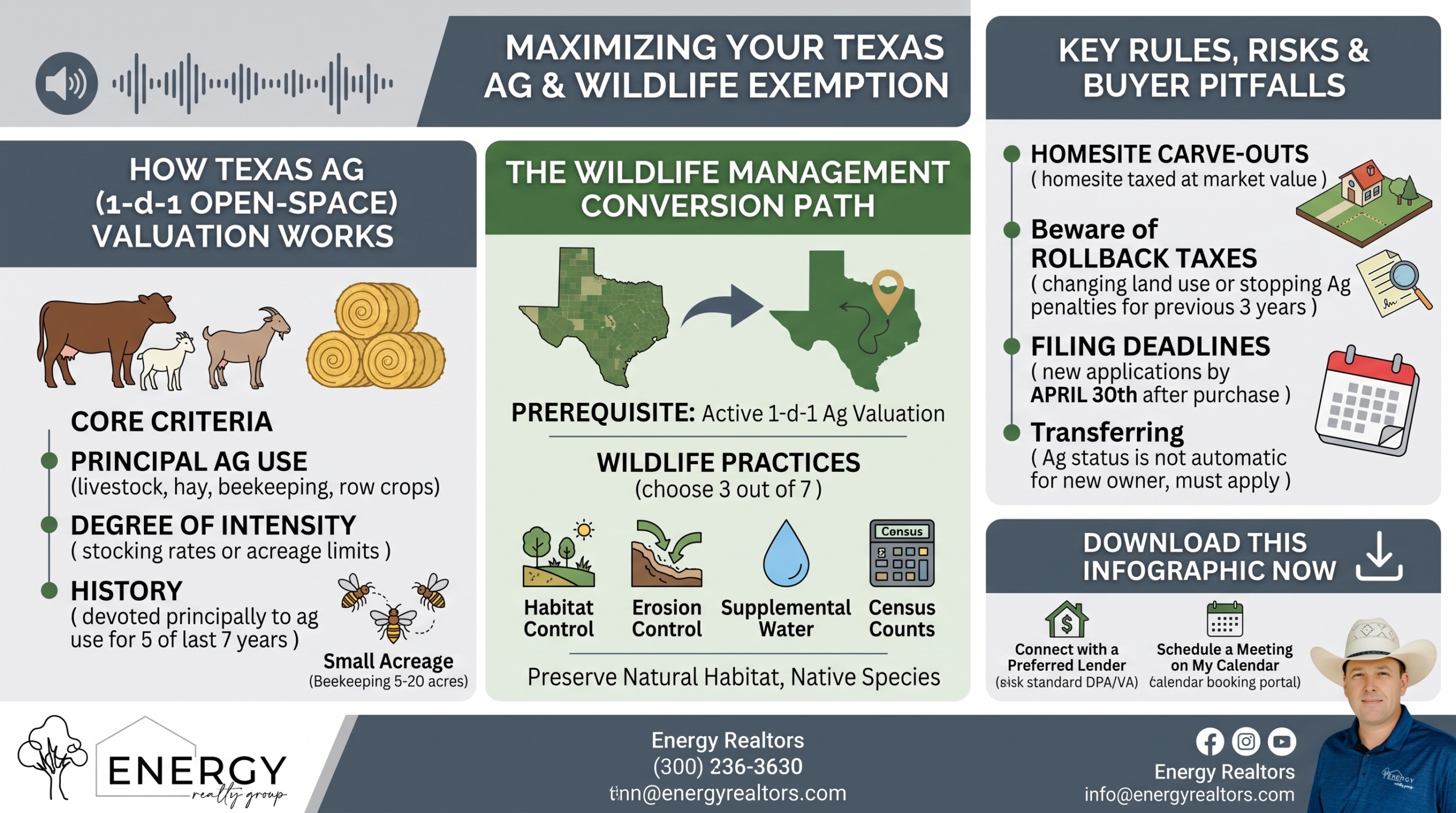
Fortunately, Texas law provides special tax relief through 1-d-1 Open-Space Agricultural Valuation (commonly called an “Ag Exemption”) and Wildlife Management Valuation. These special valuations assess land based on its productive capacity rather than its market sales value, often reducing the land portion of your annual property tax bill by 50% to 90% or more.
1. How Texas 1-d-1 Agricultural Valuation Works
It is important to note that an “Ag Exemption” is actually a special valuation method rather than a complete tax waiver. To qualify for 1-d-1 open-space valuation on acreage in North Texas, your property must meet three core criteria set by the state and local Central Appraisal District (CAD):
- Principal Agricultural Use: The primary use of the land must be active agriculture—such as livestock grazing (cattle, sheep, goats), hay production, row crops, or commercial timber.
- Degree of Intensity: Production must meet accepted local standards for intensity. Appraisal districts enforce minimum stocking rates (animal units per acre) or minimum acreage thresholds.
- 5-Out-of-7-Year History: The land must have been devoted principally to qualifying agricultural use for at least five of the preceding seven years before formal valuation is granted.
Note on Small Acreage (Beekeeping): For property owners with 5 to 20 acres who do not wish to run livestock, Texas law allows agricultural valuation through commercial beekeeping, provided the county CAD’s specific hive count standards are maintained.
2. The Wildlife Management Conversion Path
Once your land holds an active 1-d-1 Ag valuation, Texas allows you to convert to Wildlife Management Valuation without losing your favorable tax status or triggering rollback penalties.
This conversion is ideal for landowners who want to preserve natural habitat, protect native species, or reduce the daily labor of managing livestock or lease agreements.
To maintain Wildlife Management status, landowners must implement a formal management plan covering at least 3 out of 7 approved practices:
- Habitat Control: Brush management, prescribed burning, or native plant restoration.
- Erosion Control: Stream bank stabilization, pond construction, or gully planting.
- Predator Control: Managing invasive or native predator populations to protect wildlife.
- Providing Supplemental Water: Installing guzzlers, rainwater catchments, or wildlife ponds.
- Providing Supplemental Food: Planting food plots, maintaining feeders, or managing native forage.
- Providing Shelters: Installing nest boxes, brush piles, or bat houses.
- Census Counts: Conducting annual bird counts, deer spotlight surveys, or camera surveys.
3. Key Rules, Rollback Taxes & Buyer Pitfalls
When buying land with an existing Ag or Wildlife valuation, maintaining compliance is vital to avoiding costly penalties:
Homesite Carve-Outs
If you build a home on agricultural land, the immediate homesite (typically 1 to 2 acres) is carved out and taxed at standard market value, though it may qualify for a Texas General Residence Homestead Exemption. The surrounding qualified acreage retains its Ag valuation.
Filing Deadlines (Form 50-129)
When purchasing Ag-qualified property, the history stays with the land, but the valuation does not automatically transfer to the new owner. Buyers must file a new 1-d-1 application (Form 50-129) with the county CAD prior to April 30th of the year following the purchase.
Beware of Rollback Taxes
If the agricultural use of qualified land is abruptly stopped or changed to a non-qualifying commercial use, the county CAD can assess rollback taxes covering the preceding three tax years (the difference between market value taxes and Ag value taxes paid).
Navigating land purchases, CAD intensity rules, and tax valuations requires strategic planning before signing a contract. Thinking about buying or selling acreage in Parker, Hood, or Wise County?
Ready to explore rural land opportunities or evaluate your property’s tax potential? Start Your Home Buyer Strategy Session with our team today.
As a Marine Veteran and local Texas Broker, I provide straight-forward advice to help you purchase, manage, and protect your Texas land investment. Schedule a Meeting on My Calendar to map out your acreage search!

Join The Discussion