

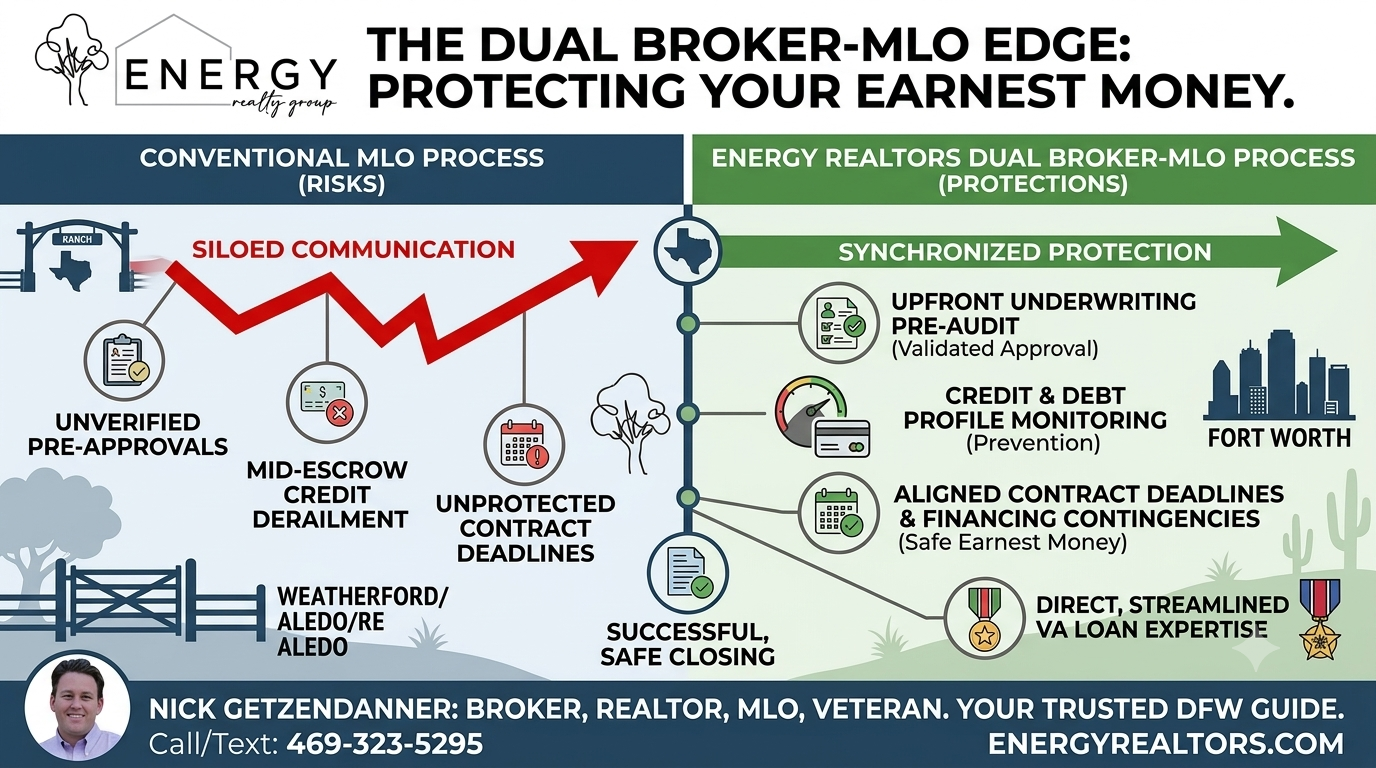
You’ve found the perfect home in Fort Worth or Parker County, submitted an offer, had it accepted, and put down thousands of dollars in earnest money. You hold a mortgage pre-approval letter from a lender, so you assume smooth sailing to the closing table. Then, two weeks before closing, the call comes: Your loan approval has been derailed.
In today’s dynamic market, mortgage underwriting audits have tightened significantly. Pre-approval letters are only as solid as the depth of the initial audit. Understanding why buyer pre-approvals fail before closing—and how structuring your transaction with a dual Broker-MLO protects your hard-earned capital—is critical to a successful transaction.
Top Reasons Buyer Pre-Approvals Fail Mid-Escrow
A pre-approval letter is an estimate based on initial credit and income documentation, not a final guarantee. Between contract execution and funding, several common issues can trigger a loan denial:
- Unverified Pre-Approvals (The “Desktop Only” Trap): Many automated online pre-approvals rely solely on unverified borrower inputs without automated underwriting system (AUS) findings or underwriter review of tax returns, bank statements, and pay stubs.
- Last-Minute Credit & Debt Profile Changes: Financing a new vehicle, buying furniture on credit prior to closing, or making significant credit card purchases alters your Debt-to-Income (DTI) ratio, potentially exceeding loan program limits.
- Undocumented Assets & Large Deposits: Lenders require a clear paper trail for earnest money and down payment funds. Sourcing issues with unverified cash deposits or unseasoned gift funds can stall underwriting approval.
- Employment or Income Adjustments: Changing jobs, transitioning from W-2 to 1099/contractor status, or experiencing changes in variable commission/bonus structure during escrow can void approval calculations.
- Property Appraisal & Condition Red Flags: A loan may fail not because of borrower qualifications, but because the property fails safety, structural, or value benchmarks—particularly under strict VA or FHA appraisal guidelines.
How a Dual Real Estate Broker & Loan Originator Protects Your Earnest Money
When your real estate agent and mortgage loan originator (MLO) operate in silos, critical communication gaps can emerge. A agent might negotiate short contingency deadlines without knowing the lender’s exact underwriting turnaround times, risking your earnest money deposit if delays occur.
Working with a dual-licensed Real Estate Broker and MLO creates end-to-end protection for your transaction:
1. Upfront Up-to-Date Underwriting Pre-Audits
Before making an offer on a home in Aledo, Weatherford, or Fort Worth, your file undergoes a thorough pre-audit. By reviewing full tax returns, income documentation, and asset statements early, potential underwriting challenges are addressed before put options or earnest money are at risk on a purchase agreement.
2. Seamless Alignment of Contract Dates & Financing Contingencies
Because the real estate representation and mortgage origination are handled synchronously, Third Party Financing Addendum dates, option periods, and appraisal timelines are crafted around verified loan processing speeds—ensuring your earnest money is fully protected under Texas contract law if an issue arises.
3. Direct Access to Competitive Rates & Direct Application
Streamlining both sides of the transaction removes unnecessary friction, offering clear visibility into market rates and loan structures. You can Check Current Rates & Apply Online directly to start a verified pre-approval process.
Steps to Secure Your Purchase Before Writing an Offer
If you are planning to purchase a home in the DFW metroplex, follow these key practices to protect your contract:
- Complete Full Income Verification Early: Avoid automated quotes; ensure W-2s, tax returns, and bank statements are audited immediately.
- Maintain Credit Freeze Status: Do not open new credit lines, buy cars, or make major purchases until loan funding is complete.
- Coordinate Contract Timelines with Loan Processing: Ensure your real estate agent aligns contract closing dates with underwriting realities.
Whether you are purchasing your first home, upgrading across Tarrant or Parker County, or utilizing your VA loan benefits, structured transaction management protects your investment from offer to key handoff.
Ready to evaluate your home buying strategy or confirm your purchasing power? Schedule a Meeting on My Calendar for a detailed strategy session today.

Join The Discussion